
The UPC’s latest costs decisions: proportionality may protect you, but procedure will not
At TheJudge, we spend a great deal of our working life on a question that sounds procedural but can be existential for a claimant: how much security for costs might the court order, and can the claimant provide it without compromising its ability to continue the case?
Two UPC decisions reported over the past fortnight provide useful guidance. Although they address different aspects of the UPC costs regime, together they illustrate how actively the Court is managing proportionality, and how unforgiving it can be when the correct application is not made at the correct time.
KEEEX v Adobe: proportionality
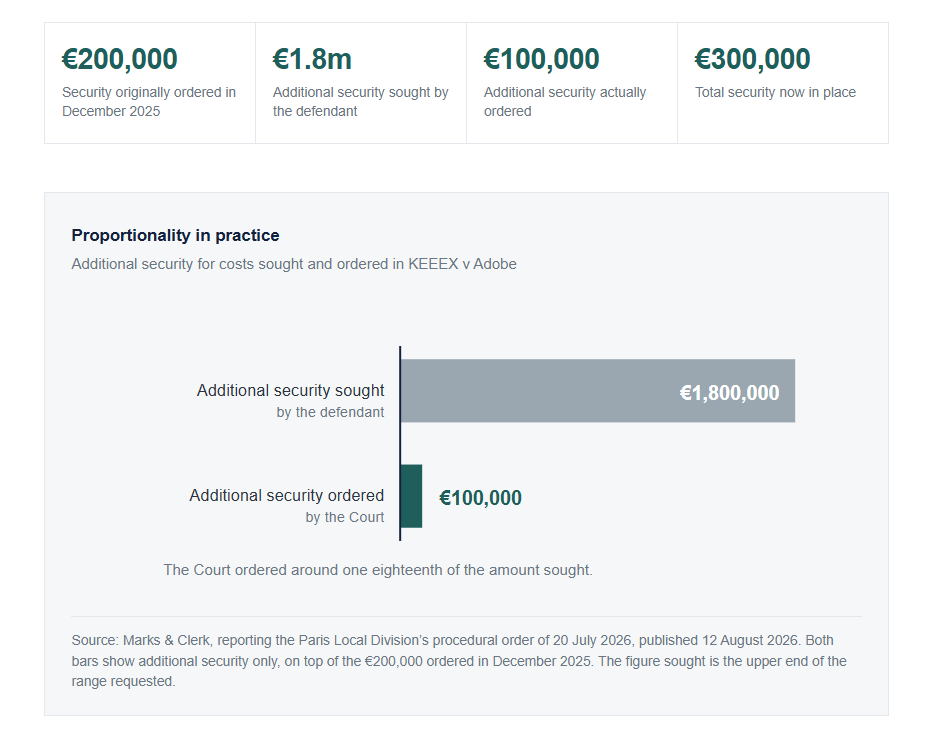
The first is the Paris Local Division’s order in KEEEX v Adobe. Security had originally been set at €200,000 in December 2025. Adobe subsequently sought additional security of up to €1.8 million after KEEEX introduced a claim for provisional damages of €120 million in its reply on the merits.
The procedural development was material. A defendant required to address a damages claim of that size will inevitably incur additional costs, and the Court accepted that a further order was justified. It nevertheless granted a top-up of only €100,000: a 50% increase, rather than anything approaching the amount Adobe had requested.
The reasoning is important. The judge declined to derive the amount of security mechanically from the applicable ceiling on recoverable costs. The Court instead considered proportionality and KEEEX’s position as a micro-enterprise founded by an individual inventor. Security at the level sought could have impaired the claimant’s right to an effective remedy under Article 47 of the Charter of Fundamental Rights of the European Union.
The Court was also unwilling to treat the ordinary features of patent litigation, including invalidity counterclaims and the complexity created by multiple defendants, as sufficient justification for the requested increase. Some of that complexity arose from the defendants’ own procedural choices.
The message is not that smaller claimants will be insulated from security applications. KEEEX was still required to increase its security from €200,000 to €300,000. It does show, however, that proportionality arguments can work and that evidence about a claimant’s size, resources and ability to continue the proceedings may materially affect the amount ordered.
Niche Biomedical v ONWARD Medical: procedure
The second decision, Niche Biomedical v ONWARD Medical, concerned the separate but related question of the ceiling on recoverable representation costs.
Niche was the successful defendant in preliminary-injunction proceedings and sought to recover costs exceeding the applicable ceiling by 50%. It argued that it had already raised the issue in its protective letter and again in its objection to the application for preliminary measures. In those documents, it had sought an interim award of costs and stated that its lawyers’ fees already exceeded the regulated maximum.
That was not enough.
The judge-rapporteur held that an application to increase the ceiling must be clear and explicit. A request for an interim award of a particular amount is not the same as a request to raise the recoverable-costs ceiling. Nor is it sufficient simply to state that the fees incurred exceed the regulated maximum.
That distinction had a decisive consequence. The Court must determine an application to vary the ceiling before deciding the substantive application and, in any event, before the conclusion of the interim proceedings. Once the decision on preliminary measures had been given, it was too late to make the necessary application.
The Court rejected the suggestion that this amounted to unnecessary formalism. Clear and specific requests are an important procedural requirement under Article 76 of the UPC Agreement. The fact that the costs issue had been mentioned at an early stage did not assist Niche because the required application had never actually been made.
The judge-rapporteur also found that an increase would not have been justified in any event, as the proceedings were not particularly complex, either factually or legally. ONWARD was ordered to pay the full amount of the applicable ceiling, but nothing beyond it.
What this means in practice
Taken together, the practical guidance for anyone bringing, defending or funding a UPC claim is fairly direct.
First, UPC cost exposure is being actively managed by the Court rather than determined solely by a formula. The ceiling on recoverable costs is a maximum, not an automatic award and not necessarily the correct measure of security. Proportionality, complexity, the parties’ procedural choices and the claimant’s financial position can all influence the result.
Second, costs applications are both time-critical and form-critical. Raising the substance of an issue is not necessarily the same as making the required application. A party seeking to increase the recoverable-costs ceiling must do so clearly, expressly and before the relevant procedural window closes.
Third, and this is where our work as litigation insurance specialists becomes particularly relevant, the amount initially ordered is not necessarily the amount for which a claimant should plan.
In KEEEX, security of €200,000 became €300,000 after the damages case developed. A claimant whose liquidity planning assumed that the original figure represented its maximum exposure could have faced a serious and immediate funding problem.
Insurance as a response
Appropriately structured adverse-costs insurance can help address that risk. A suitable policy may remove or materially reduce the Court’s concern that a future costs award will be difficult to recover, potentially avoiding the need for the claimant to place cash on deposit or support a bank guarantee.
The UPC Court of Appeal has already confirmed in Syntorr v Arthrex that appropriate litigation insurance must be considered when determining whether security is necessary at all. It set aside a €2 million security order after concluding that the claimant’s policy, supported by an anti-avoidance endorsement, removed the legitimate and real concern over recoverability.
The Court did not decide that an insurance policy can automatically substitute for a deposit or bank guarantee once security has been ordered. The distinction matters. The effectiveness of any insurance-based response will depend on the policy wording, the circumstances in which the insurer becomes liable, the protection against avoidance or cancellation, and the insurer’s financial standing.
Those points need to be addressed when the policy is structured, not after a security application has arrived.
At TheJudge, we would rather model the exposure and build the appropriate insurance structure at the outset than attempt to retrofit one under procedural and financial pressure. For anyone advising a claimant entering the UPC, particularly a smaller business or inventor-led company, the security question should be considered alongside the merits, budget and enforcement strategy from the beginning.
An otherwise viable claim can stall if the claimant cannot produce the required security when ordered. These decisions show both sides of that risk: the amount can remain proportionate if the case is made properly, but the UPC will not rescue a party that fails to ask for the right relief at the right time.
Sources: Marks & Clerk, reporting the Paris Local Division’s order in KEEEX v Adobe of 20 July 2026, published 12 August 2026; EPLAW Patent Blog, Moritz Frommberger of Dehns, on Niche Biomedical (trading as ANEUVO) v ONWARD Medical, Munich Local Division, 6 August 2026, UPC_CFI_1569/2025, published 16 August 2026; and reporting of Syntorr v Arthrex, UPC Court of Appeal, UPC_CoA_889/2025 and UPC_CoA_890/2025. This piece provides general information about insurance options and is not legal advice.KEY CONTACTS

Robert Warner, Director (UK/EU)

James Blick, Director (USA)