
A cross-border patent injunction is powerful commercial leverage. However, before taking steps to enforce it, a party should consider what happens if the legal basis for that relief later falls away.

On 7 October 2026, the District Court of The Hague ruled in favour of Halozyme in its patent dispute with Merck Sharp & Dohme (MSD) over the subcutaneous formulation of Keytruda. The court upheld the Dutch designation of EP 2 797 622, found infringement and granted an injunction against specified activities involving Keytruda SC in Belgium, Denmark, France, Ireland, Italy, Sweden, Switzerland and the Netherlands.
This was a first-instance judgment following proceedings on the merits, not an English-style interim injunction. MSD disputes the patent’s validity and infringement and has said it is considering its next steps. The wider dispute also shows how much turns on jurisdiction: Halozyme consented to revocation of the UK designation of EP 2 797 622 in May 2026, while litigation involving a different UK patent continues.
Keytruda is one of the world’s biggest-selling medicines. Its combined global sales with Keytruda Qlex reached approximately $31.7 billion in 2025, but $40 million of that came from Qlex, the newer subcutaneous formulation. The injunction concerns that formulation in eight European markets. Any damages exposure would require a separate assessment of the relevant sales, market plans, and effects of enforcement; it cannot be inferred from the global franchise total.
The price of relief
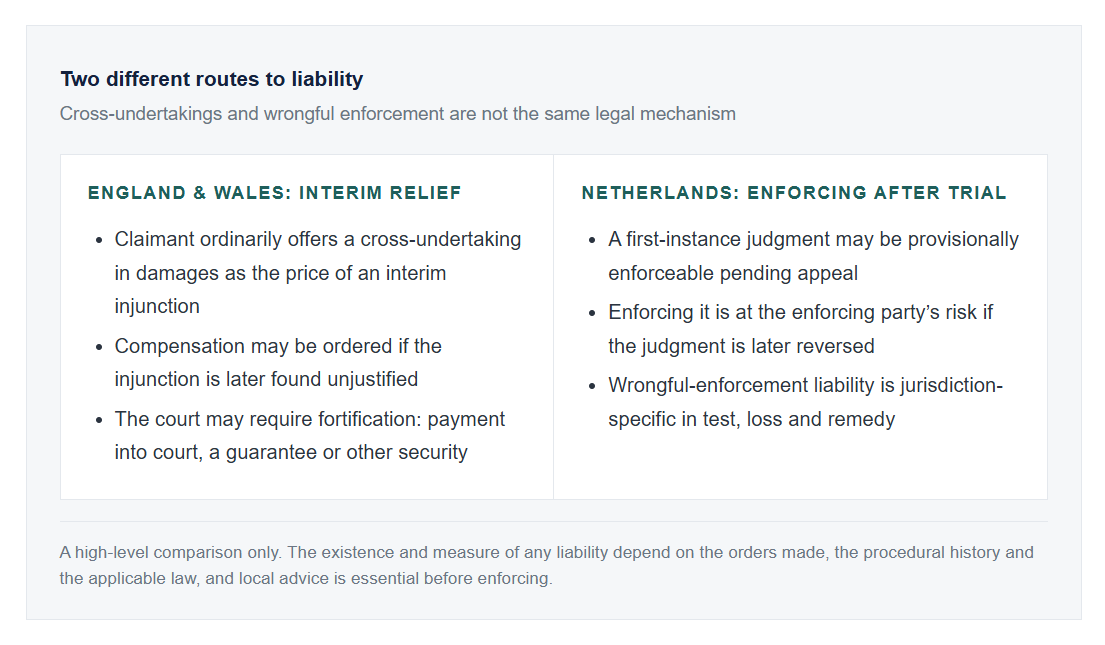
In England and Wales, a party seeking an interim injunction will ordinarily offer a cross-undertaking in damages: broadly, a promise to compensate those who suffer loss if the court later determines that the injunction should not have been granted. Depending on the case, the undertaking may need to be fortified by a payment into court, a guarantee or other acceptable security.
The exposure that comes with enforcing a provisionally enforceable judgment that may later be overturned on appeal is different again. Dutch law can impose liability for wrongful enforcement, but the test, the relevant loss and the remedies are all jurisdiction-specific. An English-style cross-undertaking should not be assumed to exist just because a Dutch court has granted an injunction at trial.
Both mechanisms raise a similar commercial question.
Could the party seeking relief absorb a substantial damages claim if the injunction proves unjustified, and should that exposure shape the decision to enforce now rather than await the appeal?
Where specialist insurance can help
Cross-undertaking in damages insurance is a specialist product designed to respond to defined liabilities arising under an insured undertaking. Subject to insurer appetite, a policy may also assist with fortification, which can reduce the need to tie up substantial cash or bank facilities. It is not an automatic substitute for court-acceptable security, and it does not remove liability above the policy limit or outside the terms of cover.
The policy wording matters as much as the limit. The insured undertaking, covered losses, trigger for payment, beneficiaries, notification obligations, exclusions and insurer security all need to match the order and the potential claim. Where enforcement spans several countries, a bespoke solution may be needed to address liabilities arising under different legal regimes; a conventional English cross-undertaking policy should not be assumed to cover them.
TheJudge has been arranging specialist cover for cross-undertakings in damages, including complex placements, for over twenty years. Clients weighing interim relief, or enforcement while an appeal remains possible, should look at the exposure and the insurance market early, before a commercial decision makes the liability real.
Sources: District Court of The Hague judgment of 7 October 2026, ECLI:NL:RBDHA:2026:29643 (EP 2 797 622); Merck 2025 full-year results, published 3 February 2026 (combined Keytruda/Keytruda Qlex sales $31.7bn; Keytruda Qlex $40m); Merck Sharp and Dohme (UK) Ltd v Halozyme Inc [2026] EWHC 1287 (Pat), 21 May 2026 (concerning consent to revocation of the UK designation). Positions on pending proceedings reflect public reporting as at 27 October 2026 and may change. This piece provides general information about insurance options and is not legal advice.KEY CONTACTS

Matthew Amey, Director

Robert Warner, Director